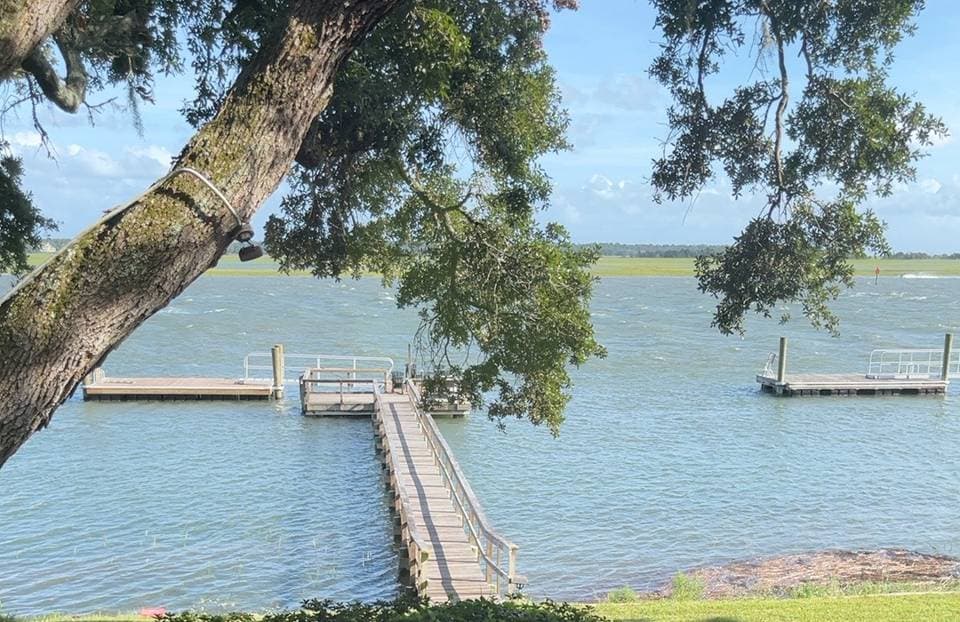
A research project at a dock.
OCEAN is a research project I'm doing with my son. He loves the deep sea. I build software. We're building a way to explore the whole ocean, from the surface to the trenches, using only real photographs, real recordings and real data, and we're connecting it to instruments we build and put in the water ourselves.
Our first instrument will be an underwater microphone at a family dock on Bohicket Creek, a tidal creek in Rockville, South Carolina. The water there is brown, fast and full of life you can't see: snapping shrimp, fish that grunt and drum, and bottlenose dolphins. Right now the site runs on a real research recording of wild dolphins while we build and test the hardware, and it's labelled as a simulation.
The question that turned this from a website into a field project was his: how could we go out on a boat and lower a camera down? So after the microphone comes a camera, tested in a pool, then from the dock, then from a boat, then deeper.
We'll write down what works and what doesn't as we go.
Rules we hold ourselves to
No AI-generated animals
Every creature picture and sound is real, and says where it came from.
Every fact shows its source
If there's a number or a claim, you can see who measured or wrote it.
A machine noticing isn't a sighting
Our software can flag a sound as a possible dolphin. Only a person listening can confirm it.
“Nobody knows yet” is an answer
A lot of the deep ocean is still unknown. We say so, because that's the exciting part.
How we use AI
AI helps us build this. One assistant does research; another checks that research against its sources and writes much of the software. AI doesn't make the pictures, and it doesn't decide what an animal was. When a program guesses at a sound, the site labels it as a guess.
See it for yourself
Take the dive from the creek to the bottom of the ocean, listen to what the node hears, or read how it works.